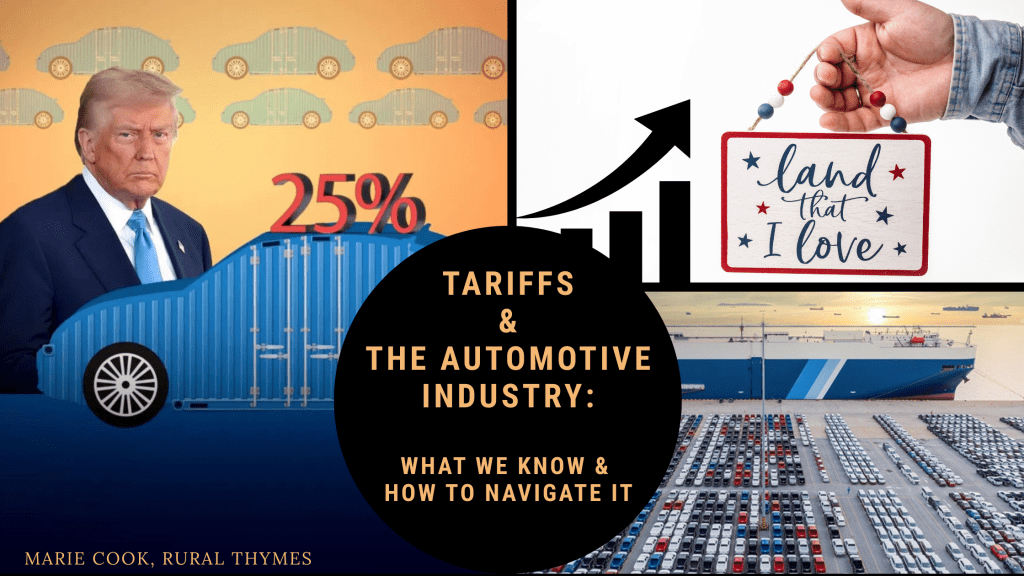
Tariffs & The Automotive Industry: What we know & how to navigate it. As told by an automotive professional.
In Q4 of 2024, I don’t think anyone could have predicted what the automotive industry had coming in Q2 2025, but here we are again, scratching our heads and wondering if this will be similar to the post-covid supply chain shortages we experienced just a few years ago. Buckle up, folks, we’re going for a ride….
Donald Trump announced on March 26th, 2025 that he would implement tariffs on parts coming from Mexico and Canada. This quickly evolved to another announcement just days later that the tariffs would extend more broadly to imported vehicles. On April 3rd, 2025, 25% tariff’s went into effect, spawning an immediate shift in the automotive industry. What exactly does this mean? Well, that’s the problem… nobody really knows yet. Some manufacturers eluded to a $4k-$10k increase in MSRP on every car, but it’s too early to tell. Forget about being proactive, dealers didn’t even have time to adjust their strategies before news anchors country-wide were telling the public to RUN to their local dealer to buy a car NOW. The National Automobile Dealers Association (NADA) reported a huge surge of business for March, reporting a 13.3% increase YOY (year over year). Interestingly enough, March 2025 also saw a seasonally adjusted annual rate (SAAR) of 17.8 million units, which represents the highest monthly SAAR in nearly 4 years!
This sounds like a good problem, doesn’t it?
“In light of these impending price hikes, a surge in consumer activity is anticipated as buyers seek to purchase vehicles before the tariffs take effect. This urgency-driven demand presents a unique, time-sensitive opportunity for dealerships to enhance sales and strengthen customer relationships.”
– Shane Unrein, Director of Advertising, Cox Automotive
Yes indeed dealers want to sell cars, and it’s wonderful when consumers are willing and able to purchase them, however, automakers seem to have a different plan and they’re pumping the brakes (pun intended). Automakers aren’t quite sure how to best respond to this crisis, but some have explored adjusting their production strategies, sourcing components differently, or modifying pricing structures to mitigate the impact. According to the New York Post, GM is increasing production of their Silverado and Sierra trucks at its plant in Indiana, which will add over 200 jobs and aim to reduce reliance on imports and mitigate the impact of tariffs. Nissan is taking a similar route in adjusting manufacturing plans. Jaguar is shifting gears mid supply-chain with a complete hault in shipments to the U.S. while they assess and address the situation. Other automakers were trying to ship as many cars as possible in an effort to make the cut before tariffs hit. In such unprecedented times, is there really a good way for automakers to respond? Regardless of how a particular automaker handles it, there will be significant impacts on inventory levels, potential supply chain disruptions, and possibly even trouble sourcing parts. Sounds familiar? – Yes, it’s like COVID all over again.

In these times, dealers have to look at their Market Day Supply as an inventory management metric to help estimate how long their inventory will last. Market Day Supply is calculated by dividing the units (inventory) by the average daily sales. For example, if there were 90 cars on that lot and the dealer was selling an average of 2 cars per day, 90/2 = 45 days of inventory. We can also look at inventory levels this way, more like balancing a checkbook…
January: Dealer starts the month off with 80 cars, receives another 50, and sells 40.
February: Dealer starts the month off with 90 cars, receives another 40, and sells 60.
March: Dealer starts the month off with 70 cars, receives another 40, and sells 70.
April: Dealer starts the month off with 40 cars, receives 30, and is on-pace to sell 70.
May: Dealer has no cars on the lot and they’re only being allocated 20 cars for the month.
Let’s walk through what this might mean for you as a consumer…. You’re interested in purchasing a family SUV and you’ve been looking at them and considering this for quite some time. You previously saw them with an MSRP of $50,000 and some had discounts up to $3,000. Depending on the month, finance rates have been about 3.9-4.9%. You go into the dealer today and learn that there’s ONE left. It’s strictly being sold at MSRP and rates just increased from last month too, changing your expected payment by a whopping $100/month. Ouch! You could just NOT buy the car, but the alternative is to pay as much as $10,000 more when the next one arrives, increasing your payment by $300 total. You opt for the one on the lot and thank the car Gods there was at least one left to choose from. As time goes on, retails are likely to have two similar vehicles in-stock, but one with an enormous price increase. Sitting side by side, who would buy the one that’s substantially more? (Stay tuned for when this happens!)
Taking an already volatile industry and adding sudden tariffs, then mixing in unknown responses from automakers, and topping it off with a rapid change in demand creates a perfect storm in the automotive industry. How we respond as retailers and consumers can make all the difference. Retailers should be transparent and honest about the situation, supply and demand, and the latest news specific to their brand. Consumers should be understanding and educated about the situation to prevent frustration. At the end of the day, we’re retailers trying to sell something, and you’re a consumer trying to buy something. Together, we can solve problems because the truth is, we’re all in this together.

Have a listen to my radio ad, airing on stations like WTSA FM!
References:
- Manzi, P. (2025). March 2025 nada market beat: New light-vehicle sales record highest Saar in nearly four years. Retrieved from https://www.nada.org/nada/nada-headlines/march-2025-nada-market-beat-new-light-vehicle-sales-record-highest-saar-nearly
- Unrein, S. (2025). Get ready for the SHIFT: Why dealers must rethink ad budgets ahead of the 25% auto tariff . Retrieved from https://www.dealer.com/resources/get-ready-for-the-shift-why-dealers-must-rethink-ad-budgets-ahead-of-the-25-auto-tariff/?brand=ddc&type=rt&program=newsletter&campaign_name=mar&utm_campaign=ddc_rt_newsletter-mar&utm_medium=marketing-email&utm_source=ddc-rt-newsletter-client-em1-202503&utm_term=client&utm_content=article1-cta-advertising-strategy&j=9192975&sfmc_sub=1096507368&l=554232_HTML&u=232247469&mid=1476201&jb=189&&jobid=9192975&batchid=189&e=
- Zilber, A. (2025). General Motors, Nissan to boost production at US plants due to Trump tariffs. Retrieved from https://nypost.com/2025/04/04/business/general-motors-nissan-to-boost-production-at-us-plants-due-to-trump-tariffs/

 Rural Thymes
Leave a comment